Key Takeaways
Binge eating disorder (BED) is a recognized DSM-5 clinical diagnosis, not a willpower problem or a moral failing. The National Institute of Mental Health classifies eating disorders as serious, treatable medical conditions.
Dietary restriction is a theorized precipitant of binge eating and one of the most common targets in treatment. Longitudinal research links dietary restraint to a higher risk of developing binge eating, which is why a stricter diet usually backfires.
A registered dietitian (RD) does not diagnose or treat BED alone. The strongest evidence supports care from a team, with a therapist, a physician, and a dietitian each playing a distinct role.
The non-diet approach rebuilds regular, adequate eating, works toward food neutrality, and helps you reconnect with hunger and fullness cues, rather than adding calorie rules.
“Near me” no longer means driving distance. Virtual care lets you work with a binge eating dietitian from anywhere in the U.S., often covered by insurance.
Searching “binge eating nutritionist near me” usually starts the same way. You have tried the plans, the tracking apps, and the promises to “be good” starting Monday. Each one worked until it didn’t, and the cycle came back a little stronger.
Here is the part diet culture never tells you. The restriction was not the fix. For many people, it was fuel for the next binge.
This guide explains how a registered dietitian helps you stop the binge-restrict cycle through non-diet, weight-neutral nutrition therapy. Not more discipline. Not another set of rules. A different relationship with food, built with a professional who understands why the old approach kept failing you.

In 30 seconds: A registered dietitian helps you stop binge eating by rebuilding regular, adequate meals, reducing the restriction that drives the binge cycle, and reconnecting you with your body’s hunger and fullness signals — without diets, calorie counting, or shame. RD nutrition therapy works best as part of a care team that can also include a therapist and physician. With virtual care, you can find a qualified binge eating dietitian anywhere in the U.S., often at little or no cost through insurance.
What is binge eating disorder — and why isn’t it about willpower?
Binge eating disorder involves recurring episodes of eating a large amount of food in a short time, along with a sense of being out of control during the episode. It became a formal, standalone diagnosis in the DSM-5 in 2013. That matters, because a clinical diagnosis reframes the whole conversation.
This is not about being lazy or lacking self-control.
It is one of the most common eating disorders in the U.S. — more common than anorexia or bulimia. The National Eating Disorders Association describes it as the second most common eating disorder, after the broader category of other specified feeding or eating disorders (OSFED). Roughly 2.7% of women and 1.7% of men experience BED over a lifetime, according to NEDA figures drawn from a 2020 Deloitte report. Some older survey data puts past-year prevalence around 1.2%, though that estimate comes from earlier research.
The point of these numbers is simple. If you are struggling with binge eating, you are far from alone, and what you are experiencing has a name, a definition, and a path forward.
Binge eating vs. emotional eating vs. occasional overeating
These three get lumped together, but they are not the same thing.
Occasional overeating is a normal human experience. A second helping at a holiday meal or eating past fullness now and then is not a disorder. It happens to everyone.
Emotional eating describes turning to food to soothe feelings like stress, boredom, or sadness. It can be a pattern worth exploring, but on its own it is not a clinical diagnosis.
Binge eating disorder is a diagnosable condition marked by recurrent binge episodes, a feeling of loss of control, and significant distress — typically at least once a week for three months.
The clearest dividing lines are the loss of control and the distress that follows. Emotional eating may overlap with a binge, but not every emotional eating moment is a binge, and not every binge is triggered by emotion.

Why restriction and dieting fuel the binge cycle
Here is the mechanism most diets ignore.
When you restrict food — cutting calories, skipping meals, or labeling foods as off-limits — your body responds the way it is designed to. Hunger hormones rise. Preoccupation with food climbs. Eventually, that pressure often breaks through as a binge, followed by guilt, followed by a renewed vow to restrict. The cycle tightens.
Researchers describe dietary restriction as a theorized key precipitant of binge eating, and dietary restraint is associated with an increased risk of developing binge eating in longitudinal studies. Restriction does not cause every binge, and it is not the only factor. But for many people, it is a powerful and often overlooked driver.
This is why “just eat less” is not neutral advice. For someone in the binge-restrict cycle, more restriction can pour fuel on the exact behavior they are trying to stop. It is also why reducing restriction is one of the most common targets in evidence-based treatment.

Can a dietitian actually help with binge eating?
Yes — and the way a dietitian helps may surprise you if you expect a meal plan and a calorie limit.
A registered dietitian who specializes in eating disorders works on the eating patterns and the food relationship underneath the binges. Rather than tightening the rules, they help you loosen the restriction that keeps the cycle spinning. Importantly, they do this as part of a team, not in isolation.
What a registered dietitian does (and doesn’t) do for BED
A registered dietitian brings clinical nutrition expertise to your recovery. Here is a realistic picture of the role.
What an RD does for binge eating:
Helps you rebuild regular, adequate eating so your body stops swinging between deprivation and bingeing.
Guides you toward food neutrality, reducing the “good food / bad food” thinking that fuels restriction.
Helps you relearn hunger and fullness cues that dieting can dull over time.
Coordinates with your therapist and physician so everyone is working from the same plan.
What an RD does not do alone:
Diagnose BED as a solo step. A dietitian can screen, recognize patterns, and refer, but formal diagnosis typically comes from a qualified medical or mental health provider.
Replace therapy. The strongest research support for reducing binge episodes is for psychotherapy, especially cognitive behavioral therapy. A 2019 meta-analysis by Hilbert and colleagues, covering 81 randomized controlled trials and 7,515 patients, found large effects for CBT-based psychotherapy in reducing binge eating.
Prescribe your body a weight-loss target. That is not the goal of this work.
In other words, nutrition therapy is a core piece of recovery, not the whole puzzle. You can read more about what a dietitian does for eating disorders to see how the role fits alongside the rest of your care team.
Registered dietitian vs. “nutritionist”: why credentials matter
When you search for a “binge eating nutritionist near me,” the results mix two very different things.
A registered dietitian (RD or RDN) holds a protected credential from the Commission on Dietetic Registration. Earning it requires graduate-level education, a supervised practice program, and a national exam, plus ongoing continuing education. For a clinical condition like BED, that training matters.
The term “nutritionist” is different. In many states — though not all — it is an unprotected title that anyone can use, regardless of training. Some nutritionists hold advanced credentials, and some do not. A recognized, advanced credential is a Certified Nutrition Specialist.
For binge eating disorder, look for a registered dietitian or certified nutrition specialist, ideally one with eating disorder experience. Every Berry Street provider is a licensed, credentialed RD or CNS, never a generic “health coach.” If you want to go deeper on the clinical distinction, this guide on whether dietitians can diagnose eating disorders is a helpful next read.
How a registered dietitian treats binge eating (the non-diet way)
Non-diet nutrition therapy is not “anything goes,” and it is not the absence of structure. It is a deliberate, weight-neutral approach that treats the cause of the cycle instead of policing the symptom.
At Berry Street, the framing is clear. We are not weight centric. We are weight inclusive. For binge eating, that stance is not only compassionate — it is clinically sound, because restriction is a well-documented binge trigger. Weight is never the goal or the measure of success in this work.
Here is what the non-diet approach actually looks like.
Rebuilding regular, adequate eating to prevent primal hunger
The foundation of recovery is often the simplest to describe and the hardest to trust: eat regularly and eat enough.
When meals are skipped or kept too small, the body eventually hits what many dietitians call primal hunger — an intense, hard-to-override drive to eat. That state makes a binge far more likely, no matter how motivated you are. Regular, adequate eating keeps hunger in a manageable range so you are making choices from a calm place, not a starving one.
A typical starting structure is three meals plus a couple of snacks, spaced across the day. The specifics get personalized to your schedule, your appetite, and your needs.

“When a new client tells me they believe the answer is more discipline or a stricter diet, I gently push back and introduce the idea of eating more, not less. Restriction isn’t the solution. We start by getting enough food in at regular times, so they don’t feel out of control by evening. Nine times out of ten, the binges shrink once the deprivation does — that’s biology finally working with them instead of against them, not willpower.” — Bridget Isaacs, MS, RD
Making peace with food: neutrality instead of ‘good’ and ‘bad’
Diet culture sorts food into moral categories: clean or junk, good or bad, allowed or off-limits. That sorting is part of the problem.
When a food is forbidden, it gains power. You think about it more, and when you finally eat it, it can feel like a rule already broken — which often turns a single portion into a binge. Food neutrality removes that charge. No food is a moral failing, and no food is off-limits.
In practice, your dietitian helps you gradually and safely reintroduce the foods you have feared, so they lose their “last supper” urgency and simply become food again.
Reconnecting with hunger and fullness cues
Years of dieting can drown out the body’s own signals. You learn to eat by the clock, the app, or the rule — not by what your body is telling you.
Nutrition therapy helps you tune back in. You practice noticing early hunger before it becomes primal, and comfortable fullness before it becomes discomfort. This is central to intuitive eating, an evidence-informed framework for rebuilding trust with your body. Regular eating comes first, because it is nearly impossible to read subtle cues when you are underfed.
“When someone is terrified that eating regularly or bringing back a ‘forbidden’ food will make them binge more or gain weight, I never dismiss that fear — it’s the cycle talking, and it’s real to them. In the first few weeks I keep it small and predictable, so their nervous system learns that food is coming and nothing catastrophic happens. Usually the opposite unfolds: as the deprivation eases, the out-of-control urgency around that food fades, and they start to feel calmer, not more chaotic, around their plate.” — Bridget Isaacs, MS, RD
Working through emotional triggers alongside your care team
Food is rarely the whole story. Stress, sleep, trauma, and difficult emotions all shape eating patterns.
Your dietitian helps you notice the practical patterns — the skipped lunch that sets up the evening binge, or the way certain routines make eating harder. When binges are tied to deeper emotional or psychological drivers, that work belongs with a therapist. This is why NEDA and clinical guidelines describe BED treatment as a coordinated effort across a physician, a therapist, and a dietitian. Each professional handles their piece, and they communicate so your care stays consistent.
What to expect: your first appointment and beyond
Starting is often the scariest part. Knowing what happens next can make it feel less daunting.
The first session and personalized plan
Your first appointment is a conversation, not a test. Your dietitian asks about your history with food and dieting, your typical day of eating, your relationship with your body, and what you want to feel differently.
There is no weigh-in requirement to “earn,” no food diary to be graded, and no lecture. From there, you build a starting plan together. Because there is no one-size-fits-all approach, that plan is tailored to your life, your schedule, and your individual needs — and it flexes as you go.
Cadence, progress, and the Berry Street app between visits
Recovery is not linear, and progress is measured in behaviors and your relationship with food — never in pounds. Wins look like eating lunch consistently, getting through a fear food without panic, or noticing fullness before discomfort.
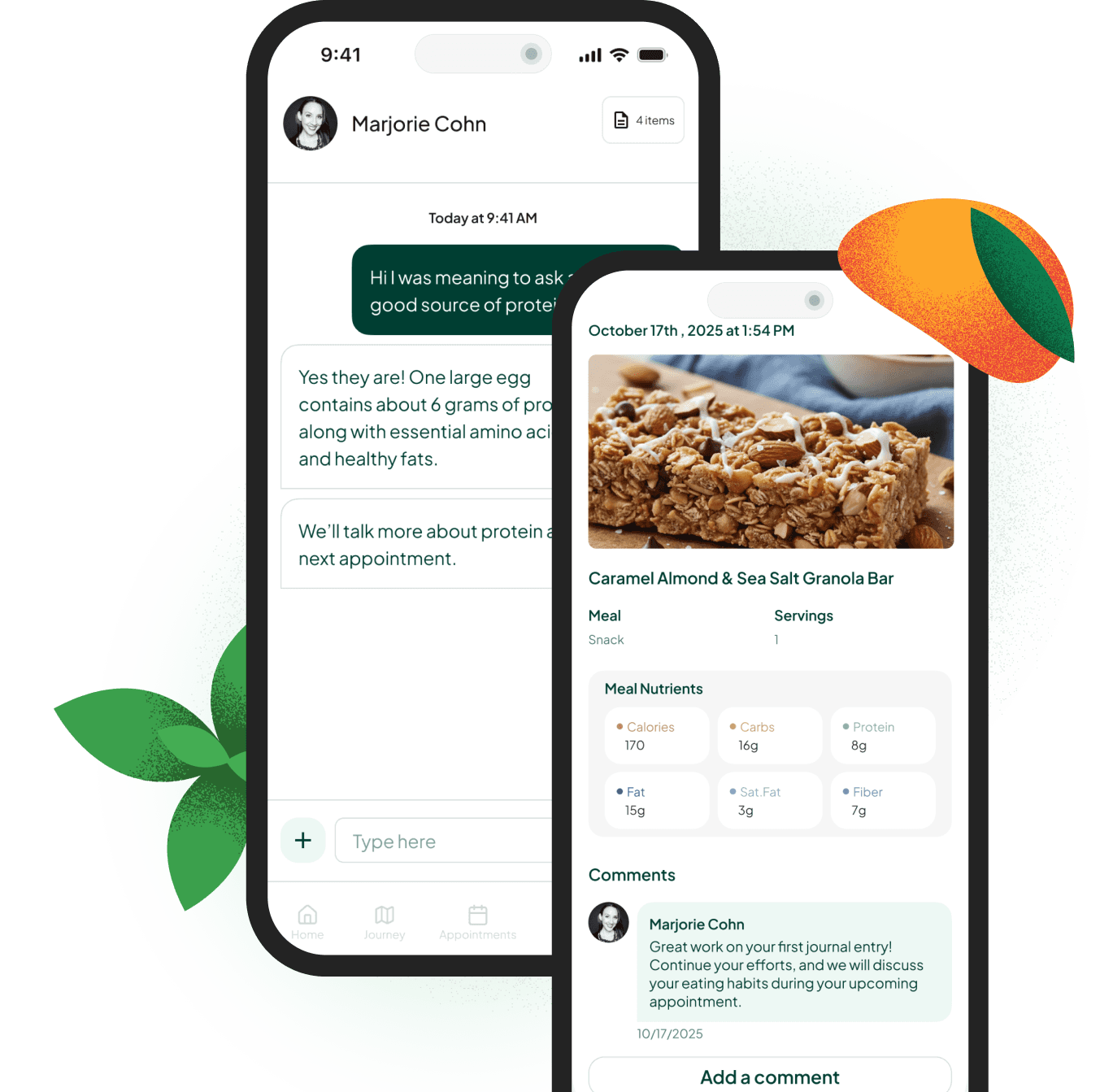
Appointment cadence is personalized. Many people start with more frequent visits and space them out over time as things stabilize. Between sessions, the Berry Street app lets you message your dietitian, and it offers tools like photo-based meal logging and integration with wearables and lab data, so support does not stop when the video call ends.
How long does it take? Honestly, it varies. Some people notice steadier eating within a few weeks, while a durable shift in the food relationship often unfolds over months, depending on your individual needs.
How to find a binge eating dietitian near you
The good news: finding the right specialist is easier than it used to be, and geography is far less of a barrier than most people assume.
Virtual care means ‘near me’ is anywhere in the U.S.
If you have searched “binge eating dietitian near me” and come up short, virtual care changes the math. With telehealth, “near me” effectively means anywhere in the U.S.
You are no longer limited to the handful of providers within driving distance. You can match with a registered dietitian who specializes in eating disorders, even if they practice in another state. Berry Street offers fully virtual visits, so there is no commute and no waiting room — just a video appointment that fits your day.

Is a binge eating dietitian covered by insurance?
Cost is one of the biggest reasons people delay getting help. It often does not have to be a barrier.
Nutrition counseling is frequently covered by insurance. Berry Street is in-network with 1,250+ insurance plans, and 95% of Berry Street members pay $0 out of pocket. You can check your coverage in about 60 seconds by entering your state and insurance details, with no commitment required.
A quick note on referrals: with Berry Street you can usually book without a referral, though some plans require one, so it is worth checking yours. Coverage specifics depend on your individual plan.
A safer alternative to AI and diet-culture advice
It can be tempting to type your questions into a chatbot or a search bar at 2 a.m. Be careful here.
General diet advice from social media and generic AI tools is not built for someone in the binge-restrict cycle, and it can be actively harmful. Researchers at the Harvard T.H. Chan School of Public Health have reported that some AI tools can generate harmful advice related to eating disorders. A credentialed dietitian offers the opposite: individualized, weight-neutral, evidence-based care from a real person who is accountable to a clinical standard.
Getting support that fits your life
If the binge-restrict cycle has worn you down, the next step does not have to be dramatic. It just has to be different from what has not worked.
You do not need more willpower. You do not need a stricter plan. You need support built around your actual life, from a registered dietitian who understands the cycle and how to help you step out of it.

When you are ready, you can check your coverage and book a visit in about a minute. Most members pay $0, there is no pressure, and you can go at your own pace.
Frequently Asked Questions
What does a registered dietitian do for binge eating disorder?
A registered dietitian helps you rebuild regular, adequate eating, reduce the restriction that fuels binges, and reconnect with your hunger and fullness cues. The focus is on your relationship with food, not calorie rules or weight loss. This work is most effective alongside a therapist and physician as part of a care team.
What’s the difference between a nutritionist and a registered dietitian for binge eating?
A registered dietitian (RD or RDN) holds a protected credential requiring graduate education, supervised practice, and a national exam. “Nutritionist” is an unprotected title in many states, meaning anyone can use it regardless of training. For a clinical condition like binge eating disorder, a credentialed RD with eating disorder experience is the safer choice.
How do I find a binge eating dietitian near me?
Look for a registered dietitian who specializes in eating disorders, and remember that virtual care removes the distance barrier. With telehealth, “near me” can mean anywhere in the U.S. You can match with a specialist through Berry Street and confirm coverage in about 60 seconds online.
Is seeing a dietitian for binge eating covered by insurance?
Nutrition counseling is often covered by insurance. Berry Street is in-network with 1,250+ plans, and 95% of members pay $0 out of pocket. You can check your specific coverage in about 60 seconds with no commitment required.
Can a dietitian diagnose binge eating disorder?
A dietitian can screen for binge eating, recognize the patterns, and refer you for evaluation, but a formal diagnosis typically comes from a qualified medical or mental health provider. Dietitians work alongside your doctor and therapist, not instead of them. This team approach is the standard for BED care.
How is binge eating disorder treated without dieting or restriction?
Non-diet treatment rebuilds regular, adequate eating, works toward food neutrality instead of “good” and “bad” foods, and helps you relearn hunger and fullness cues. Because restriction is a recognized binge trigger, removing it is part of the treatment, not a compromise. Psychotherapy, especially CBT, provides the strongest evidence for reducing binge episodes.
Can I see a binge eating dietitian online or virtually?
Yes. Virtual nutrition therapy is widely available and just as personalized as in-person care. Berry Street offers fully virtual visits across all 50 states, with no commute or waiting room.
How long does it take to stop binge eating with a dietitian?
It varies by person. Some people notice steadier, calmer eating within a few weeks, while a durable shift in the food relationship often unfolds over months. Your timeline depends on your individual needs, your history, and the rest of your care team.
What happens in the first appointment with a binge eating dietitian?
The first session is a conversation about your history with food and dieting, your typical eating patterns, and what you want to change. There is no test, no lecture, and no required weigh-in to earn. Together you build a personalized starting plan tailored to your life.
Does a dietitian work with my therapist or doctor for BED?
Yes, and that coordination is a key part of effective care. Clinical guidance describes binge eating disorder treatment as a team effort across a physician, a therapist, and a dietitian. Each professional handles their part and communicates so your care stays consistent.
Will working with a dietitian make me gain weight?
The goal of this work is a stable, trusting relationship with food and adequate nourishment — not any particular number on a scale. Body changes vary from person to person and are not the aim of care. For some people, weight may shift in either direction as eating stabilizes, depending on individual needs, and your dietitian supports you through it without making weight the measure of success.
What’s the difference between binge eating, emotional eating, and overeating?
Occasional overeating is a normal experience that happens to everyone. Emotional eating is turning to food to cope with feelings, and on its own it is not a clinical diagnosis. Binge eating disorder is a diagnosable condition marked by recurrent episodes, a sense of loss of control, and real distress.
Last Reviewed by Bridget Isaacs, MS, RD — October 2026.