Key Takeaways
A virtual dietitian consultation is a private video appointment with a licensed registered dietitian, delivered securely from wherever you feel comfortable.
Registered dietitians (RD/RDN) are credentialed medical professionals, and the title is legally protected in a way that “nutritionist” often is not.
Research suggests telehealth nutrition care is comparable to in-person care for many people, with the added benefit of easier access.
Most of the appointment is a conversation about your health history, routine, and goals, not a lecture or a generic meal plan handed to you.
With Berry Street you can often check coverage in about 60 seconds, and 95% of members pay $0 with in-network insurance.
A virtual dietitian consultation can deliver expert nutrition care comparable to an in-office visit, through a secure video call you can join from home. You skip the commute and the waiting room. You keep the clinical credibility, the personalized plan, and the licensed professional on the other side of the screen. If you are curious but a little nervous about booking your first online dietitian consultation, this guide walks you through exactly how it works, what to expect, and how to prepare.
In 30 seconds: A virtual dietitian consultation is a one-on-one video visit with a registered dietitian who reviews your health history, listens to your goals, and builds a nutrition plan around your real life. It is private, HIPAA-compliant, and clinically credible. For many people it works as well as an in-person appointment, and it is often covered by insurance.
What Is a Virtual Dietitian Consultation?
A virtual dietitian consultation is a scheduled appointment with a registered dietitian that happens over secure video instead of in a clinic. You log in from your phone, tablet, or computer. Your dietitian reviews your history, asks questions, and helps you build a plan you can actually follow.
Think of it as telehealth nutrition counseling. For most people, the clinical care translates well over video, and the delivery is simply more flexible.
That flexibility matters. No commute, no waiting room, no rearranging your whole day around one appointment. You get expert online nutrition counseling that fits into your schedule instead of fighting it.
At Berry Street, every visit is fully virtual by design. You can book video sessions on your schedule, message your dietitian between visits, and track your progress with support at each step. If you want a broader picture of the experience, our guide on what to expect when seeing a dietitian covers it in detail.

Virtual vs. in-person — what’s actually different (and what isn’t)
Let’s be clear about the differences, because most of them are smaller than people expect.
What’s different:
Location. You join from home or anywhere private, instead of driving to an office.
Convenience. Scheduling around work, childcare, or travel is usually easier.
Between-visit access. Many virtual programs, including Berry Street, offer messaging with your dietitian between appointments.
What’s the same:
The clinician. You still work with a licensed registered dietitian, not a chatbot or a generic coach.
The assessment. Your dietitian still reviews your history, labs, medications, and goals.
The personalization. Your plan is still built around your body, your routine, and your preferences.
The core of the visit is a conversation. That conversation translates just as well over video as it does across a desk. What you lose is the drive. What you keep is the care.
Who a registered dietitian is (RD/RDN credential) vs. a “nutritionist”
This distinction matters more than most people realize. A registered dietitian nutritionist (RD or RDN) is a licensed medical professional with years of clinical training, qualified to help treat and manage medical conditions.
The title is protected. According to the Academy of Nutrition and Dietetics, “registered dietitian nutritionist” is a credential earned through accredited education, supervised practice, and a national exam. By contrast, the word “nutritionist” has no standardized meaning, and in most states anyone can use it regardless of training.
That does not make every non-RD unqualified. It does mean the RD/RDN credential guarantees a specific level of clinical education and accountability. In some states, a Certified Nutrition Specialist (CNS) is a qualified, advanced credential. When your health is involved, that matters.
A registered dietitian also works alongside your doctor, not instead of them. Your dietitian can coordinate with your care team, review your labs, and build nutrition strategies that support your medical treatment. If you want a deeper comparison, see our breakdown of nutritionist vs. dietitian.


Is a Virtual Dietitian Consultation as Effective as an In-Person Visit?
Here is the honest answer. For many people, a virtual dietitian consultation delivers results comparable to an in-person visit, and research is increasingly supportive.
The value of a nutrition appointment comes from the relationship, the assessment, and the follow-through. None of those depend on sharing a physical room. What they depend on is a skilled clinician, a clear plan, and consistent contact. Telehealth supports all three.
What the research shows
The evidence base for telehealth nutrition care is growing. The U.S. Department of Health and Human Services notes that “telehealth plays an increasingly important role in supporting nutrition and healthy eating,” and points to improved access as a key benefit.
Individual studies point the same direction, with appropriate caution. One 2024 study in the journal Healthcare followed adults and found no significant differences between telehealth and in-person groups in measures like body composition, along with higher attendance in the telehealth group. It was a small, non-randomized study of 62 people over 12 weeks in Saudi Arabia, so it is something to note rather than the final word.
Diabetes care shows a similar pattern. In a 2024 study by Mori and colleagues in Nutrients, telehealth nutrition education was non-inferior to face-to-face education for blood-sugar (HbA1c) management in people with type 2 diabetes. This was also a small study conducted in Japan, so results should be read as encouraging rather than definitive.
Taken together, the research suggests that for many people, virtual nutrition counseling is a credible option, not a compromise. Your results will still depend on your individual needs, your goals, and the plan you build with your dietitian.

How a Virtual Dietitian Consultation Works, Step by Step
Wondering what the process actually looks like? Here is the full journey, from checking coverage to your first follow-up.
Step 1 — Check your insurance coverage (60-second check)
Start with cost, because that is the question on most people’s minds. With Berry Street, you can check your coverage in about 60 seconds by entering your state and insurance provider, with no commitment required.
Berry Street is in-network with 1,250+ insurance plans, 95% of members pay $0, and billing follows a no-surprises promise. You see what you will pay before you commit to anything.
Wondering whether you need a referral first? It depends on your plan. Many plans allow direct access, and with Berry Street you can often book without a referral. Some plans require one, so check yours to be sure.
Step 2 — Get matched with a dietitian who specializes in your goals
Once you know your coverage, the next step is matching. You are not dropped into a random schedule. You are paired with a registered dietitian who specializes in your goals and health history.
This matters because nutrition is personal. A dietitian who focuses on gut health brings different expertise than one who focuses on prenatal nutrition or diabetes. The right match means your first conversation starts with relevant understanding, not a blank slate.
Step 3 — Complete a short intake before your visit
Before your first session, you will complete a brief intake form. This usually covers your health history, current medications and supplements, any recent labs, and what you hope to get out of care.
The intake does two things. It gives your dietitian a head start, so you spend less session time on paperwork. It also helps you organize your own thoughts before you log on.
Step 4 — Your first video session: the comprehensive assessment
Your first appointment is the comprehensive assessment. This is usually the longest visit, often around 60 to 90 minutes, and it sets the foundation for everything that follows.
Your dietitian will ask about your eating patterns, your routine, your health goals, your relationship with food, and any conditions you are managing. This is a conversation, not a test. There are no wrong answers and no judgment about what you eat.
By the end, your dietitian has a clear picture of your life. That picture is what makes the next step possible.
Step 5 — Your personalized nutrition plan
Next comes your plan. This is built specifically for you, based on your assessment, your preferences, and what realistically fits your days.
A good plan is not a rigid list of rules or a set of foods to fear. It is a set of practical, personalized steps you can actually sustain. If weight change is part of your goals, it can be addressed as one possible outcome among several, and you and your dietitian decide together what success looks like for you.
There is no one-size-fits-all approach here. Your plan flexes with your needs, and you can adjust it with your dietitian over time.
Step 6 — Follow-ups, messaging between visits, and progress tracking
Nutrition change happens between appointments, not just during them. That is why follow-ups matter.
In ongoing visits, you and your dietitian review what is working, troubleshoot what is not, and refine your plan. Follow-up sessions are usually shorter than the first, and your cadence is tailored to you. Some people meet weekly at first, others every few weeks.
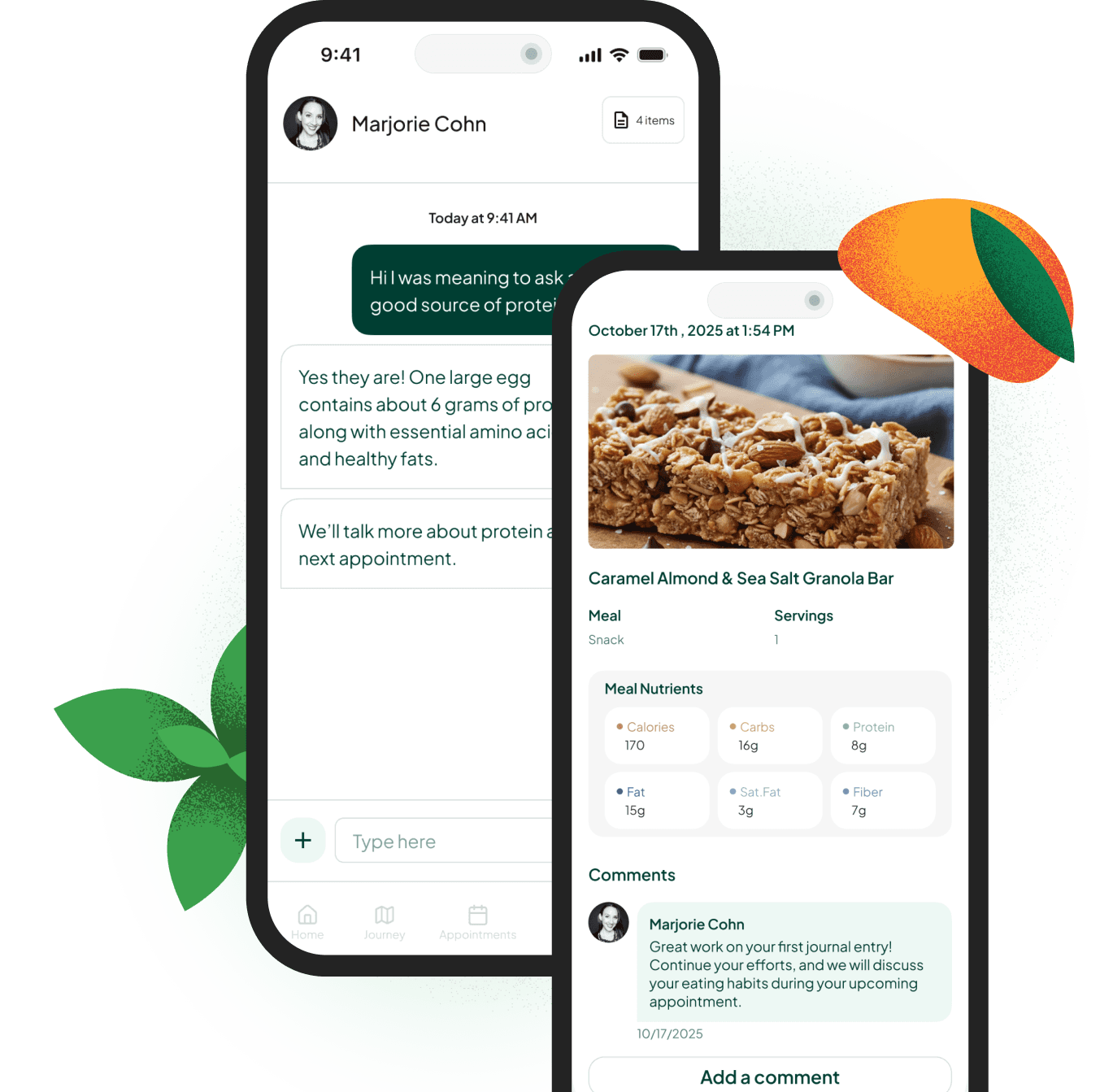
With Berry Street, you can also message your dietitian between visits and track your progress in the app, which supports meal logging and can connect with wearable devices and lab data. For a fuller sense of the ongoing relationship, see how a dietitian helps a patient.
What You’ll Talk About in Your First Session
Your first virtual nutrition appointment is mostly about you. Expect an open, structured conversation rather than a lecture.
Common topics include:
Your health history — conditions, symptoms, family history, and any diagnoses you are managing.
Your current eating patterns — what a typical day of eating looks like, without judgment.
Your routine and constraints — work, sleep, stress, budget, cooking time, and who you cook for.
Your relationship with food — past experiences with dieting, stress eating, or restriction.
Your goals — what “feeling better” means to you, in your own words.
Notice what is missing from that list. No judgment, no foods labeled off-limits, no shame about where you are starting. The goal is understanding, so your plan reflects your real life.
If you are worried a screen will make the visit feel impersonal, you are not alone. Here is what your dietitian would want you to know.
“Honestly, some clients tell me virtual visits feel more personal, not less. You’re in your own kitchen, so we can look in your fridge together, and you’re not rushing out of a waiting room. I get to see your real setup, your real schedule, and your real life, and that helps me tailor advice that actually fits. The screen disappears about two minutes in, once we start talking.” — Bridget Isaacs, MS, RD
How to Prepare for Your Virtual Nutrition Appointment
A little preparation makes your first visit smoother and more useful. You do not need to do much, but a few small steps help.
What to have ready
Gather these before your appointment so you are not scrambling mid-session:
Recent lab results — bloodwork or other tests, if you have them handy.
Medications and supplements — a simple list of what you take, including doses if you know them.
A few food notes — a rough sense of what you have eaten over the last few days.
Your questions — write down anything you want to ask, so nothing slips your mind.
You do not need a perfect food diary or a full medical file. Whatever you have is enough to start, and your dietitian can fill in the rest.
The tech you need + setting up a private, quiet space
The technology is simple. You need a smartphone, tablet, or computer with a camera, a microphone, and a stable internet connection. Most platforms run in your browser or a basic app, so there is usually nothing complicated to install.
For the space itself, pick somewhere private and quiet where you can speak freely. A closed door helps. Good lighting and a charged device help too. If you can, test your camera and sound a few minutes early, so the visit starts on time.

Is a Virtual Consultation Private and Secure?
Yes. A legitimate virtual dietitian consultation runs on a HIPAA-compliant, secure platform designed to protect your health information.
That means your video visit, your records, and your messages are handled with the same privacy protections as any medical appointment. Your information is encrypted and access is restricted to your care team.
At Berry Street, the process is HIPAA-compliant and secure from the coverage check onward. Privacy is not an add-on. It is built into how virtual care is supposed to work. If a service cannot clearly explain how it protects your data, treat that as a reason to look elsewhere.
What a Virtual Dietitian Can Help You With
A virtual dietitian is not only for one narrow goal. Registered dietitians provide medical nutrition therapy across a wide range of conditions, working alongside your doctor.
Common areas of support include:
Diabetes and pre-diabetes — blood-sugar management and everyday eating strategies.
Gut health — IBS, digestion, and food sensitivities.
PMOS — nutrition support for hormonal and metabolic health.
Heart health — eating patterns that support cardiovascular care.
Eating disorders and disordered eating — compassionate, specialized care.
GLP-1 support — nutrition guidance to help protect muscle, manage side effects, and sustain results for people using GLP-1 medications.
Whatever brings you in, the approach is personalized. Your dietitian meets you where you are, not where a generic plan assumes you should be.
“My first session is mostly listening. I want to know what your mornings look like, who you’re cooking for, what you actually enjoy eating, and where your day tends to fall apart. Then we pick one or two changes that fit into the life you already have. A realistic plan you can follow on a busy week night beats a perfect plan you’ll abandon midweek.” — Bridget Isaacs, MS, RD
Getting Started With a Virtual Dietitian
Starting is simpler than you might expect. There is no rush and no pressure, just a clear first step.
Begin by checking your coverage, which takes about 60 seconds and asks only for your state and insurance provider. Remember, Berry Street is in-network with 1,250+ insurance plans, 95% of members pay $0, and billing follows a no-surprises promise.
From there, you can book a virtual visit with a registered dietitian matched to your goals. You choose the time. You join from home. You start building a plan around your real life, at your own pace.

Frequently Asked Questions
Is a virtual dietitian consultation as effective as an in-person visit?
For many people, yes. Research suggests telehealth nutrition care is comparable to in-person care, and one 2024 study in Healthcare found no significant differences in body-composition outcomes between the two. Your results still depend on your individual needs and the plan you build with your dietitian.
What actually happens during your first virtual dietitian appointment?
Your first visit is a comprehensive assessment, usually around 60 to 90 minutes over secure video. Your dietitian reviews your health history, routine, and goals through an open conversation. By the end, you have the first steps of a personalized nutrition plan.
How much does a virtual dietitian consultation cost, and is it covered by insurance?
Nutrition counseling is often covered by insurance. Berry Street is in-network with 1,250+ insurance plans, 95% of members pay $0, and billing follows a no-surprises promise. You can check your coverage in about 60 seconds and see your cost before committing.
What technology or equipment do I need for an online dietitian visit?
You need a smartphone, tablet, or computer with a camera, a microphone, and a stable internet connection. Most platforms run in your browser or a simple app. Testing your camera and sound a few minutes early helps the visit start on time.
How should I prepare for my first virtual nutrition consultation?
Have your recent labs, a list of medications and supplements, and a few notes about your recent meals ready. Write down any questions so nothing slips your mind. You do not need a perfect food diary, whatever you have is enough to start.
Are virtual dietitian consultations private and HIPAA-secure?
Yes. A legitimate virtual consultation runs on a HIPAA-compliant, secure platform, so your video visit, records, and messages are protected. At Berry Street, the process is HIPAA-compliant and secure from the coverage check onward. Your information is encrypted and access is limited to your care team.
How long is a virtual dietitian appointment, and how often will I meet?
First appointments often run about 60 to 90 minutes, and follow-ups are usually shorter. Your cadence is tailored to you, so some people meet weekly at first and others every few weeks. You and your dietitian decide together what schedule fits your needs.
Can a virtual dietitian help with a specific condition like diabetes, PMOS, or gut health?
Yes. Registered dietitians provide medical nutrition therapy for conditions including diabetes, PMOS, gut health, heart health, eating disorders, and GLP-1 support. Your care is personalized to your health history and goals, and your dietitian can work alongside your doctor.
What’s the difference between a virtual dietitian and a nutritionist?
A registered dietitian (RD/RDN) is a licensed medical professional whose title is legally protected and earned through accredited education, supervised practice, and a national exam. According to the Academy of Nutrition and Dietetics, “nutritionist” has no standardized meaning, and in most states anyone can use it. All Berry Street providers are credentialed dietitians or certified nutrition specialists.
Can a virtual dietitian work alongside my doctor?
Yes. A registered dietitian works alongside your doctor, not instead of them. Your dietitian can review your labs, coordinate with your care team, and build nutrition strategies that support your medical treatment.
How do I find and book a virtual dietitian covered by my insurance?
Start by checking your coverage, which takes about 60 seconds with your state and insurance provider. Whether you need a referral depends on your plan. Many plans allow direct access, and with Berry Street you can often book without one, though some plans require a referral, so check yours.
What happens after my first virtual consultation?
You move into follow-up visits, where you and your dietitian review progress, troubleshoot challenges, and refine your plan. With Berry Street, you can message your dietitian between visits and track your progress in the app. Nutrition change happens between appointments, and consistent support is what makes it stick.
Last Reviewed by Bridget Isaacs, MS, RD — October 2026