Key Takeaways
An online registered dietitian (RD or RDN) is a licensed medical professional. Virtual care does not change their training, credentials, or scope of practice.
“Registered dietitian” is a legally protected title, but “nutritionist” is not regulated in many states, so anyone can use it regardless of training.
A nutrition coach can support habits and accountability, but coaches should not diagnose conditions or provide medical nutrition therapy.
You can verify any dietitian’s credentials in about 5 minutes using the free CDR Credential Verification System.
Virtual RD care is often covered by insurance. Berry Street is in-network with 1,250+ plans, and most members pay $0.
If you have ever typed “online registered dietitian” into a search bar and felt unsure who was actually qualified, you are not alone. The internet is full of people offering nutrition help, and the labels blur together fast. Registered dietitian, nutritionist, nutrition coach, wellness expert. Some of these titles mean years of clinical training and a license. Some mean a weekend certificate. This guide walks you through how to tell the difference yourself, so you can choose care with confidence instead of guessing.
In 30 seconds: Yes, a real online registered dietitian is legitimate and just as qualified as one you would see in person. The catch is that “nutritionist” and “nutrition coach” are not always credentialed titles. Learn to check for the RD or RDN credential and verify it in the national registry, and you can spot the difference in minutes.
On this page
Short answer: yes, a real online RD is legit — but “nutritionist” and “nutrition coach” aren’t always
Registered dietitian vs. nutritionist vs. nutrition coach: what the titles actually mean
Are online nutrition coaches qualified to help you?
How to verify an online dietitian’s credentials in 5 minutes
Is an online (virtual) dietitian as effective as in-person?
What can an online registered dietitian actually help with?
How to get started with a legit online dietitian (usually $0 with insurance)
Frequently Asked Questions
Short answer: yes, a real online RD is legit — but “nutritionist” and “nutrition coach” aren’t always
Here is the reassuring part first. A registered dietitian who sees you over video is every bit as legitimate as one who sees you in an office. The screen does not lower the bar. The same credential, the same license, and the same scope of practice apply whether the visit happens in a clinic or your kitchen.

The uncertainty usually comes from everything around that word. “Dietitian” sits next to “nutritionist,” “coach,” and “expert” in your search results, and those other titles do not carry the same guarantees. Knowing which is which is the whole game.
Why this question matters more online than ever
Online nutrition help has exploded, and that is mostly good news. It means care can reach you no matter where you live or how packed your schedule is. It also means the filter that a physical office once provided is gone.
In a search feed, a licensed clinician and someone who finished a short online course can look nearly identical. Both may have a polished website, a friendly headshot, and confident language about “transforming your relationship with food.” The difference is not in the marketing. It is in the credential behind the name, and that is something you can check for yourself.

The one distinction that changes everything (licensed vs. unregulated)
If you remember one thing from this article, make it this. The most reliable signal of a qualified nutrition professional is a protected, licensed credential rather than a self-applied label.
Registered dietitians hold a protected title tied to national credentialing and, in most states, a license. According to the Academy of Nutrition and Dietetics, the “nutritionist” title is not protected in many states, which means someone can use it without any specific education or supervised training. That single distinction is what separates a medical professional from a well-meaning enthusiast. Everything else in this guide builds on it.

Registered dietitian vs. nutritionist vs. nutrition coach: what the titles actually mean
Let’s define the three titles you are most likely to run into, so the differences stop feeling fuzzy. Think of this as a spectrum of training and scope, not a ranking of who cares more about your health.
Registered Dietitian / RDN — a licensed medical professional
A Registered Dietitian, also written as Registered Dietitian Nutritionist (RDN), is a licensed medical professional qualified to treat and manage medical conditions. The two titles mean the same thing. RDN simply makes the “nutritionist” role explicit.
Becoming an RD is not quick. It requires a bachelor’s degree in a relevant field, a supervised practicum of roughly 1,000 hours, passing a national board exam, and ongoing continuing education to stay credentialed. As of 2024, according to the Commission on Dietetic Registration, a graduate degree is also required to sit for the exam. Because of this training, dietitians can deliver medical nutrition therapy and work alongside your physician, not instead of them. If you want a fuller picture of the day-to-day, this overview of how a dietitian helps a patient is a good next read.

“Nutritionist” — sometimes credentialed (CNS), often not a protected title
“Nutritionist” is where things get slippery. In some states the word is regulated, and in many it is not. That means the same title can describe a highly trained clinician or someone with no formal credential at all.
There is a genuinely rigorous version of the title worth knowing. A Certified Nutrition Specialist (CNS) holds an advanced degree, completes 1,000 hours of supervised practice, and passes a board exam, which makes it a credible credential. Depending on state licensure laws, a CNS may also be authorized to provide medical nutrition therapy.
The problem is that “nutritionist” on its own tells you nothing about which situation you are in. If you are weighing this label specifically, our take on whether a nutritionist is worth it breaks down when the title does and doesn’t come with real training.
Nutrition coach — accountability and habits, not medical nutrition therapy
A nutrition coach usually focuses on motivation, accountability, and building day-to-day habits. Many hold a certificate from a coaching program, and many are genuinely skilled at helping people stay consistent. That work has real value.
What a coaching certificate does not include is the clinical training to diagnose, treat, or manage a medical condition. This is not a knock on coaches. It is simply the line their credential draws. Understanding that line helps you match your needs to the right professional instead of expecting medical care from a role that was never designed to provide it.
Are online nutrition coaches qualified to help you?
So, are online nutrition coaches qualified? The honest answer is: qualified for some things, not for others. A good coach can be a real asset. The key is knowing where their lane ends and a clinician’s begins.
What a nutrition coach can legitimately do
Within a general-wellness scope, coaches can do a lot of genuinely helpful work. They tend to shine at the behavioral side of eating, which is exactly where many people get stuck.
Accountability and consistency: regular check-ins that help you follow through on goals you have already set.
Habit building: support for routines like planning meals, eating regularly, or staying hydrated.
General education: explaining broad, non-medical concepts about balanced eating for healthy adults.
Motivation and mindset: encouragement and structure when you know what to do but struggle to keep it going.
What a nutrition coach should NOT do (medical nutrition therapy, diagnosing, treating conditions)
Here is where the credential line matters most. A coach without clinical licensure should not step into medical territory, both for your safety and because it falls outside their training.
Diagnosing conditions: interpreting symptoms or labs to name a medical problem.
Providing medical nutrition therapy: designing a clinical nutrition treatment for a diagnosed condition like diabetes, kidney disease, or an eating disorder.
Managing disease: adjusting nutrition to treat a health condition, especially one involving medication.
Overriding your medical team: telling you to change or stop a prescribed treatment.
If an online provider offers to “treat,” “cure,” or “manage” a medical condition without holding a clinical credential, treat that as a red flag rather than a selling point.
When a coach isn’t enough — signs you need an RD
Sometimes a coaching relationship is a good fit, and sometimes your situation has simply outgrown it. A few signs suggest it is time to move to a registered dietitian:
You have a diagnosed condition, such as diabetes, PMOS, IBS, or heart disease.
You are on medication that interacts with food or nutrient needs.
Your symptoms are getting worse, not better, despite consistent effort.
You want care that coordinates with your doctor and can be billed to insurance.
“When a client tells me their online coach has them ‘eating clean’ but their blood sugar is still all over the place, or they have a real diagnosis and the plan is the same generic template that everyone else got, that is my cue to step in. The tell is usually one of three things: the advice never changes based on your labs or symptoms, the person cannot explain the clinical reasoning behind it, or they do not have credentials to support medical conditions. A coach can be great for keeping you consistent. But the moment a medical condition or a medication is in the picture, you deserve someone licensed to actually treat it, and it is completely okay to switch.” — Bridget Isaacs, MS, RD
How to verify an online dietitian’s credentials in 5 minutes
You do not have to take anyone’s word for it. Verifying a dietitian’s credentials is fast, free, and something you can do before you ever book a visit. Here is the step-by-step.
Look for RD or RDN after their name
Start with the letters. A legitimate dietitian will list RD or RDN after their name, often alongside a master’s abbreviation like MS and state license letters such as LDN or LD.
Be a little cautious with vague phrasing like “nutrition expert,” “certified nutritionist,” or “wellness specialist” with no recognized credential attached. It does not automatically mean unqualified, but it does mean you should keep verifying rather than assume.
Check the CDR Credential Verification System (step-by-step)
The single best tool is free and public. The Commission on Dietetic Registration (CDR) maintains an official registry of every credentialed dietitian, and you can search it yourself.
Go to the CDR Credential Verification System and find the credential verification search.
Enter the professional’s first and last name.
Confirm the name matches and that the credential is listed as active and in good standing.
If you cannot find them, ask directly for their registration number and try again, or treat the gap as a reason to look elsewhere.
Confirm state licensure and telehealth compliance
Most states also license dietitians separately, and a licensed provider must be authorized to practice in the state where you live. For virtual care, that is the state you are physically in during the visit.
Reputable telehealth platforms handle this matching for you by pairing you with a dietitian licensed in your state. It is still fair to ask, “Are you licensed to see patients in my state?” A confident, clear answer is a good sign.
Questions to ask before your first session
A short list of questions can settle any lingering doubt. Before your first session, consider asking:
Are you a registered dietitian (RD or RDN), and what is your registration number?
Are you licensed in my state?
Do you have experience with my specific condition or goal?
Do you bill insurance, and can you check my coverage before we start?
Is the platform HIPAA-compliant?
Is an online (virtual) dietitian as effective as in-person?
A common worry is that a video visit must be a watered-down version of the real thing. It is a reasonable concern, and the evidence is genuinely reassuring on this point.
What the research shows on telehealth nutrition care
For many people, virtual nutrition care works as well as sitting in an office. A 2016 systematic review by Kelly and colleagues found that telehealth dietary interventions were effective for managing chronic disease. Research also suggests that dietitian counseling produces measurable clinical results in general. A 2019 review by Ross and colleagues reported that consultations with a dietitian were associated with improvements in blood lipid levels, including triglycerides.
The comparison is holding up as more research comes in. A 2024 study in Nutrients by Mori and colleagues found that telehealth nutrition care was non-inferior to in-person care for improving HbA1c in people with type 2 diabetes, meaning the virtual group did about as well on a key blood sugar marker. For many people, the flexibility of virtual visits also makes it easier to keep showing up, and consistency is where nutrition change actually happens.
Privacy, HIPAA, and how virtual visits work
Legitimate virtual nutrition care runs on secure, HIPAA-compliant platforms, the same privacy standard that protects any other medical record. Your sessions and messages stay confidential.
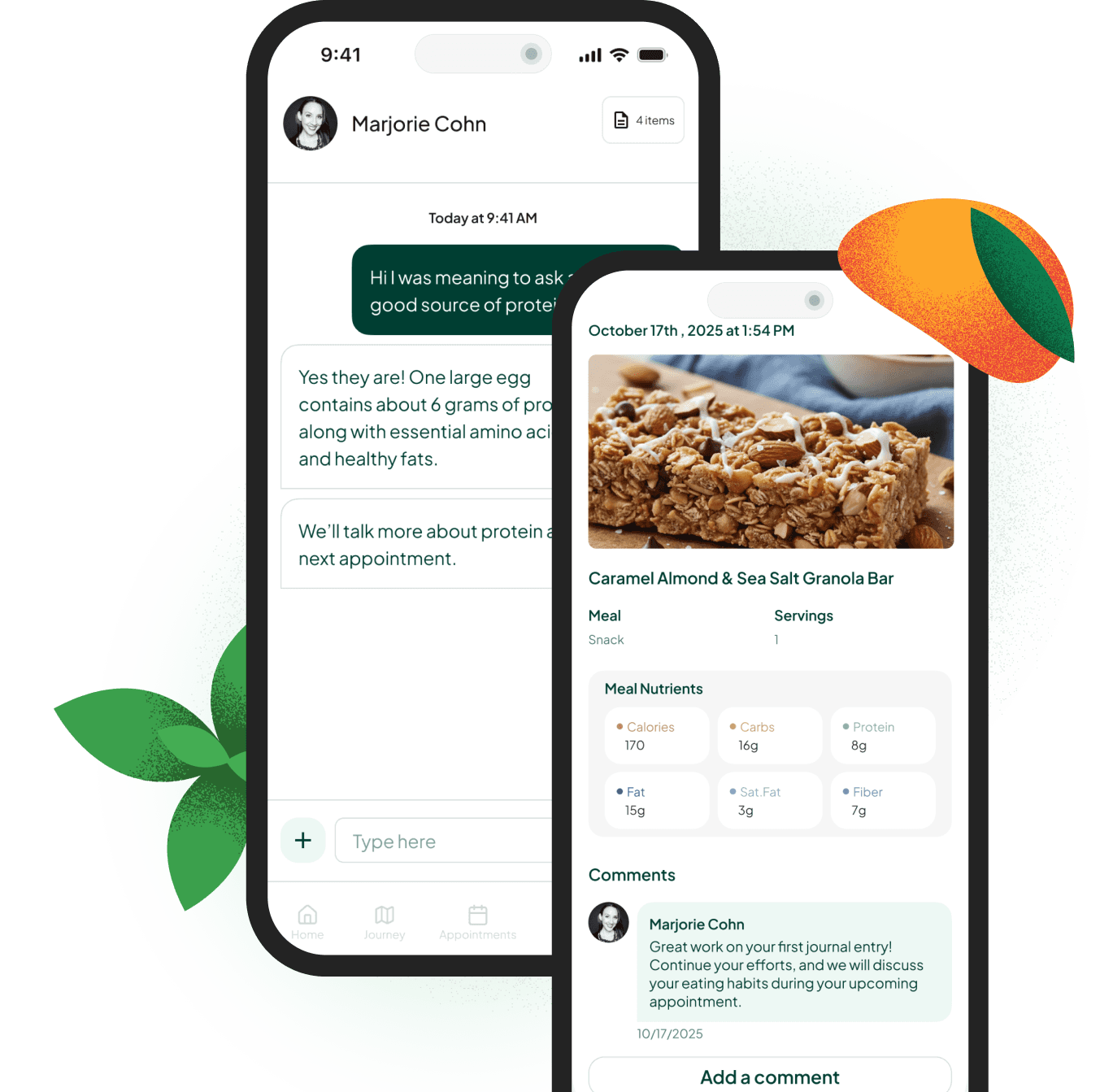
The visit itself is straightforward. You meet your dietitian over video, talk through your health history, goals, labs, and daily routine, and leave with a personalized plan. Between visits, many platforms let you message your dietitian, share updates, and adjust as life changes.

“I hear the nerves about video visits a lot, and here is what actually happens. In our first session, we review your history, I am asking about your labs, your medications, your schedule, your stress, what your fridge actually looks like on a Tuesday night. We discuss your bloodwork and adjust the plan in real time. Nothing about that gets lost over video. If anything, I get a more honest picture, because you are in your own kitchen instead of an office, and people tend to open up more when they are comfortable.” — Bridget Isaacs, MS, RD
What can an online registered dietitian actually help with?
An online RD can help with a wide range of needs, from managing a specific diagnosis to simply feeling steadier day to day. Because they are trained clinicians, their scope covers real medical nutrition therapy, not just general tips.
Medical conditions RDs manage (diabetes, PMOS, gut health, heart health, eating disorders)
Registered dietitians are qualified to provide nutrition therapy for many conditions, often as part of a care team that includes your doctor. Common examples include:
Diabetes and pre-diabetes: aligning eating patterns with blood sugar management and any medications.
PMOS: supporting hormonal and metabolic health with an individualized approach. You can explore Berry Street’s PMOS nutrition support for more on what that care looks like.
Gut health and IBS: working through symptoms and food tolerance without unnecessary restriction.
Heart health: supporting cholesterol, blood pressure, and cardiovascular risk through nutrition.
Eating disorders: delivering specialized, non-shaming care, ideally within a treatment team.
This is exactly the kind of clinical work that sits outside a coach’s scope, which is why the credential matters so much when a diagnosis is involved.
A note on weight loss, in a sustainable, realistic way
Weight often comes up, so let’s talk about it plainly and without the pressure.
Weight change may happen as one possible outcome of better nutrition for many people, but it is not the only measure of whether you are healthier. The focus is on building eating patterns that fit your life, support your labs and energy, and feel sustainable. If weight loss is part of your personal goals, you can work with a dietitian to personalize this rather than chase a number through over restriction. The point is a plan that works for your body, not against it.
How to get started with a legit online dietitian (usually $0 with insurance)
Getting started with a qualified online dietitian is more affordable than most people expect, mainly because insurance often covers it. Nutrition counseling is a covered benefit on many plans, which removes the cost barrier that stops a lot of people from getting help.

Soft CTA — check coverage in 60 seconds, get matched
Here is a simple way to begin. Berry Street connects you with registered dietitians who take your insurance, and the first step is just checking your coverage.
Check coverage in about 60 seconds. Enter your state and insurance provider, with no commitment required.
See your cost up front. Berry Street is in-network with 1,250+ plans, and most members pay $0.
Get matched to the right RD. You are paired with a dietitian who specializes in your goals and health history, all licensed and verifiable.
When you are ready, you can check your coverage and get matched with a registered dietitian. If you want to keep comparing your options first, this guide to finding the best online nutritionist for personalized advice is a helpful companion piece.
Frequently Asked Questions
Is an online registered dietitian as effective as an in-person one?
For many people, yes. Research suggests telehealth nutrition care can match in-person care, and a 2024 study in Nutrients found virtual visits were non-inferior to in-person visits for improving HbA1c in type 2 diabetes. The credential and scope of practice are identical whether the visit is virtual or in an office.
How do I check if an online dietitian is actually credentialed?
Search their name in the free CDR Credential Verification System at cdrnet.org, which lists every credentialed dietitian in the country. Confirm the credential is active and in good standing. You can also ask directly for their registration number and state license.
What’s the difference between a registered dietitian and a nutrition coach?
A registered dietitian is a licensed medical professional who can provide medical nutrition therapy and help manage diagnosed health conditions. A nutrition coach typically focuses on habits, accountability, and general wellness, without the clinical training to treat medical conditions. Both can be valuable for different needs.
Are online nutrition coaches qualified to give medical advice?
Coaches without a clinical credential are not qualified to diagnose or treat medical conditions or provide medical nutrition therapy. They can legitimately support habits, motivation, and general healthy-eating education. If a coach offers to “treat” or “manage” a diagnosed condition, that is a reason to look for a registered dietitian instead.
Is “nutritionist” a protected or regulated title?
Not in many states. According to the Academy of Nutrition and Dietetics, “nutritionist” is not a protected title in many places, so someone can use it without specific education or training. A Certified Nutrition Specialist (CNS) is a rigorous version of the title, but the word alone does not guarantee credentials.
Does insurance cover an online registered dietitian?
Often, yes. Nutrition counseling is a covered benefit on many insurance plans. Berry Street is in-network with 1,250+ plans, and most members pay $0, and you can check your specific coverage in about 60 seconds before committing.
Can an online dietitian help with a condition like diabetes or PMOS?
Yes. Registered dietitians are trained to provide medical nutrition therapy for conditions including diabetes, PMOS, gut health issues, heart health, and eating disorders. They often work alongside your physician as part of your care team, and this care translates well to virtual visits.
What credentials should a legitimate online nutrition professional have (RD, RDN, CNS)?
Look for RD or RDN, which indicate a registered dietitian and a licensed medical professional. CNS (Certified Nutrition Specialist) is another rigorous, board-certified credential. You can verify RD and RDN credentials through the CDR registry, and many dietitians also hold a state license shown as LD or LDN.
What can a nutrition coach do that a dietitian can’t — and vice versa?
Coaches often excel at accountability, motivation, and habit building, and some are more focused on that ongoing day-to-day support. Dietitians can do that too, and they can additionally provide medical nutrition therapy, help manage diagnosed conditions, and bill insurance. The dividing line is clinical licensure.
Is online nutrition counseling private and HIPAA-compliant?
Reputable virtual nutrition platforms are HIPAA-compliant, which means your sessions and health information are protected by the same privacy standard as any medical record. Your visits, messages, and records stay confidential. It is fair to confirm this before your first appointment.
How much does an online dietitian cost without insurance?
Out-of-pocket costs vary by provider and location, and can commonly range from roughly $100 to $200 per session without insurance. Because nutrition counseling is often a covered benefit, many people pay far less or nothing. Checking your coverage first is the best way to know your real cost.
What questions should I ask before hiring an online nutrition provider?
Ask whether they are a registered dietitian (RD or RDN) and for their registration number, whether they are licensed in your state, and whether they have experience with your specific condition or goal. Also ask if they bill insurance and whether the platform is HIPAA-compliant. Clear, confident answers are a good sign.
Last Reviewed by Bridget Isaacs, MS, RD — October 2026.