Key Takeaways
Medical nutrition therapy (MNT) is a clinical treatment delivered by a registered dietitian nutritionist (RDN), not general diet advice, and it works alongside your doctor and the rest of your medical team.
“Nutritionist” and “registered dietitian” are not the same thing. An RDN is a credentialed clinician who completed supervised training and a national exam, while “nutritionist” has no standardized national meaning, though some states do regulate the title.
For many chronic conditions, the goal is better clinical markers and daily function, such as A1c, blood pressure, cholesterol, energy, and quality of life, not a number on the scale.
Research suggests virtual MNT can help many people reach outcomes similar to in-person care, with the added benefits of easier access, flexible scheduling, and more consistent follow-up between visits.
Most virtual nutrition therapy is covered by insurance. Berry Street is in-network with 1,250+ plans, and 95% of members pay $0.
You were handed a diagnosis and a long list of foods to avoid. Maybe a pamphlet. Maybe a five-minute conversation at the end of an appointment that already ran late. What you did not get was someone to sit with you and show you how to actually eat with type 2 diabetes, high blood pressure, or kidney disease in a way that fits your budget, your culture, and your busy weekday night.
That gap is real, and it is common. Managing a chronic condition is a daily job, and being told what not to eat is not the same as being supported. Virtual, insurance-covered care with a registered dietitian is designed to close that gap. You meet by video from home, you message your dietitian between visits, and you build a plan around your life instead of around a list of restrictions.
This guide explains how online medical nutrition therapy works, what the research says, and how to check whether your plan covers it.
On this page
What is medical nutrition therapy (MNT), and how is it different from general diet advice?
Which chronic conditions can medical nutrition therapy help you manage?
Does virtual nutrition therapy actually work as well as in-person care?
What a virtual nutrition therapy appointment actually looks like
Is virtual medical nutrition therapy covered by insurance?
Getting started with a virtual dietitian for your chronic condition
Frequently Asked Questions
In 30 seconds: Medical nutrition therapy is a clinical, evidence-based treatment delivered by a registered dietitian or certified nutrition specialist to help you manage a chronic condition, and it can be delivered effectively over video. For many people it improves markers like A1c, blood pressure, and cholesterol, and it is often covered by insurance with no out-of-pocket cost.
What is medical nutrition therapy (MNT), and how is it different from general diet advice?
General diet advice is the stuff you can find anywhere. Eat more vegetables. Drink more water. Cut back on sodium. It is not wrong, but it is generic, and it does not account for your labs, your medications, your other conditions, or how your body actually responds to food.
Medical nutrition therapy is different. MNT is a structured clinical treatment, delivered by a registered dietitian or certified nutrition specialist, that uses your specific health data to manage or treat a diagnosed condition. It is prescribed and documented like other medical care, and it is designed to work alongside your physician, not replace anything they are doing. Think of it as the difference between a tip you read online and a treatment plan built for your body. If you want a deeper look at the clinical side, this overview of medical nutrition therapy goes further.
The four steps of MNT: assessment, diagnosis, intervention, monitoring
MNT follows a consistent clinical process. It is not improvised, and it is not a one-time handout. Here is how it typically works.
Assessment. Your dietitian reviews your labs, medications, medical history, weight history, symptoms, eating patterns, culture, budget, and goals. This is the fact-finding stage, and it is thorough on purpose.
Nutrition diagnosis. Based on the assessment, your dietitian identifies the specific nutrition-related problems to address, such as blood sugar that spikes after certain meals or a sodium pattern that may be affecting your blood pressure.
Intervention. You and your dietitian build a plan together. This includes concrete, personalized changes and the coaching to make them stick, tailored to what you are already doing well.
Monitoring and evaluation. Your dietitian tracks your progress against your markers and goals, then adjusts the plan. Chronic conditions change over time, and your plan should change with them.
That last step is where virtual care has a real advantage, because ongoing monitoring is easier when your dietitian is a video call or a message away.

“Nutritionist” vs. registered dietitian — who is actually qualified to provide MNT
This distinction matters, especially for a medical condition. A registered dietitian nutritionist (RDN) is a credentialed clinician. Earning the credential requires an accredited degree, a supervised practice program, a national exam, and ongoing continuing education, according to the Academy of Nutrition and Dietetics. RDNs are qualified to provide MNT and to treat and manage medical conditions.

The word “nutritionist” is different. On its own, it has no standardized national meaning, which means the qualifications behind it can vary widely from person to person. There is an important caveat here: some states do regulate the title and set their own requirements, so the rules depend on where you live. A certified nutrition specialist (CNS) is an advanced credential, awarded by the Board for Certification of Nutrition Specialists, that offers a pathway to state licensure for nutrition practice and MNT in some states. When you are managing a chronic condition, it is worth confirming that the person guiding your care is a credentialed RDN or CNS. If you want the full breakdown, here is a guide to the difference between a nutritionist and a dietitian.
At Berry Street, every provider is a licensed, credentialed registered dietitian or certified nutrition specialist, so you always know who you are working with.

Which chronic conditions can medical nutrition therapy help you manage?
Food affects nearly every system in your body, so MNT can support a wide range of conditions. The through-line is the same across all of them. The goal is to improve how you feel and how your condition is tracking clinically, not to hit a number on the scale. Weight change may happen for some people as a side effect of better nutrition, but it is not the point, and your dietitian will help you focus on the markers that actually reflect your health.
The Academy of Nutrition and Dietetics 2026 position paper concluded that RDN-delivered MNT is effective for many chronic, nutrition-related conditions, and that the evidence points to meaningful value for patients and the health system alike.
Metabolic — type 2 diabetes, prediabetes, high cholesterol
Metabolic conditions are some of the most common reasons people start MNT. For type 2 diabetes, a dietitian helps you understand how different meals affect your blood sugar and builds an eating pattern that supports steadier glucose and a healthier A1c, coordinated with any medications you take. You can learn more on the Berry Street diabetes care page.
For prediabetes, the evidence is encouraging. A 2023 systematic review and meta-analysis by Dudzik et al. in the American Journal of Clinical Nutrition found that dietitian-delivered MNT improved fasting glucose, lipids, and blood pressure in adults with prediabetes compared with standard care. Research suggests it may also improve A1c, though the certainty of that specific finding is low, so it is best understood as a promising signal rather than a guarantee. For high cholesterol, MNT focuses on the fats, fibers, and overall eating patterns that influence your lipid panel, personalized to your labs and preferences.

Heart & kidney — heart health, chronic kidney disease, high blood pressure
Your heart and kidneys are deeply connected to what you eat, and both respond well to personalized nutrition care. For heart health and high blood pressure, a dietitian helps you work on sodium, potassium, fiber, and overall dietary patterns in a way that fits your tastes rather than stripping your plate bare. You can explore the Berry Street heart health page for more.
Chronic kidney disease is a good example of why credentialed care matters. Kidney-friendly eating often involves balancing protein, sodium, potassium, and phosphorus, and those targets shift depending on your stage of kidney function and your labs. This is detailed, individualized work, and it is exactly what a renal dietitian is trained to do alongside your nephrologist.
Digestive, hormonal, and other conditions (IBS, PMOS, thyroid, and more)
MNT also helps with conditions where food and symptoms are closely linked. For irritable bowel syndrome (IBS), a dietitian can guide a structured, temporary approach to identifying triggers so you are not cutting out foods unnecessarily or living on a shrinking list of “safe” meals. No food is off-limits by default. The aim is to find your pattern.
For PMOS, nutrition can support blood sugar, energy, and hormonal health, with a plan built around your goals rather than a restrictive template. The Berry Street PMOS care page covers this in more detail. Thyroid conditions, autoimmune conditions, liver disease, and many others can also benefit from MNT. Because each of these interacts differently with food and medication, it is worth working with a dietitian to personalize the approach to your situation.
“When a client comes in overwhelmed by everything they’ve been told not to eat, we don’t start with a list of rules. We start with what a normal day actually looks like for them, and what’s already working. Then we pick one or two changes that fit their schedule and budget, like adjusting the order they eat foods at dinner or adding protein to breakfast. For someone with type 2 diabetes or high blood pressure, small, doable shifts they can keep are what actually move A1c and blood pressure over time.” — Bridget Isaacs, MS, RD
Does virtual nutrition therapy actually work as well as in-person care?
This is a fair question, and the honest answer is nuanced. Research suggests that, for many people, virtual RD care can achieve outcomes similar to in-person care. At the same time, some evidence indicates that in-person contact may offer additional benefits for certain people and goals. Virtual care is not automatically better or worse. It is a delivery method that works well for a lot of people, and your dietitian can help you figure out whether it fits your needs.
What the research shows on telehealth-delivered MNT
A few findings help set expectations. An evidence-based guideline from the Academy of Nutrition and Dietetics, published in 2023, found similar outcomes for in-person versus blended delivery in weight management, while noting that in-person contact may offer additional benefits. Separately, a small 2024 non-inferiority trial by Mori et al. in Nutrients found telenutrition was non-inferior to face-to-face care for blood sugar management in adults with type 2 diabetes. That study was small, with 30 participants in Japan, so it is one data point rather than the final word, but it points in a consistent direction.
The takeaway is measured, not hyped. For many people managing a chronic condition, virtual MNT can deliver real clinical results, and the format makes it easier to keep showing up, which matters more than most people expect.
Where virtual care shines — access, scheduling, and staying consistent
Consistency is where virtual care earns its keep. Chronic conditions are managed over months and years, not in a single visit, and the format removes a lot of the friction that causes people to drop off.
Access. You can work with a dietitian who specializes in your condition even if there is not one near you, which matters for conditions like CKD or PMOS.
Scheduling. No commute and no waiting room means it is easier to fit a visit into a workday or around caregiving.
Consistency. Video visits plus messaging between appointments make it easier to stay on track and adjust in real time instead of waiting months for the next opening.
Cost-effectiveness lines up with this too. A 2023 review by Kelly et al. in Nutrition Reviews found that telehealth-delivered nutrition interventions are likely cost-effective from a health-system perspective, with about 60% of the studies reviewed supporting that conclusion.
What a virtual nutrition therapy appointment actually looks like
If you have never done this before, the process is more straightforward than you might expect. Here is what to anticipate from matching through ongoing support.
Matching with the right dietitian for your condition
You do not get randomly assigned to whoever is available. The goal is to pair you with a dietitian who specializes in your condition and understands your health history, because managing diabetes is different from managing CKD, which is different from managing IBS. A good match means less time explaining the basics and more time building your actual plan. When you get matched with a dietitian, your condition, goals, and preferences guide the pairing.
Your first video visit and building your plan
Your first visit is mostly a conversation. Your dietitian walks through the assessment, asking about your labs, medications, symptoms, routines, culture, budget, and what you have already tried. From there, the two of you build a first plan together, one grounded in your real life rather than an ideal one. You will not be handed a rigid meal plan and sent on your way. You will leave with a few clear, doable next steps and a shared sense of what you are working toward.
Because this is clinical care, your dietitian works alongside your medical team. They can align your nutrition plan with your medications and lab targets, and they can communicate with your doctor so everyone is rowing in the same direction.
Between-visit support — messaging, tracking, and working with your medical team
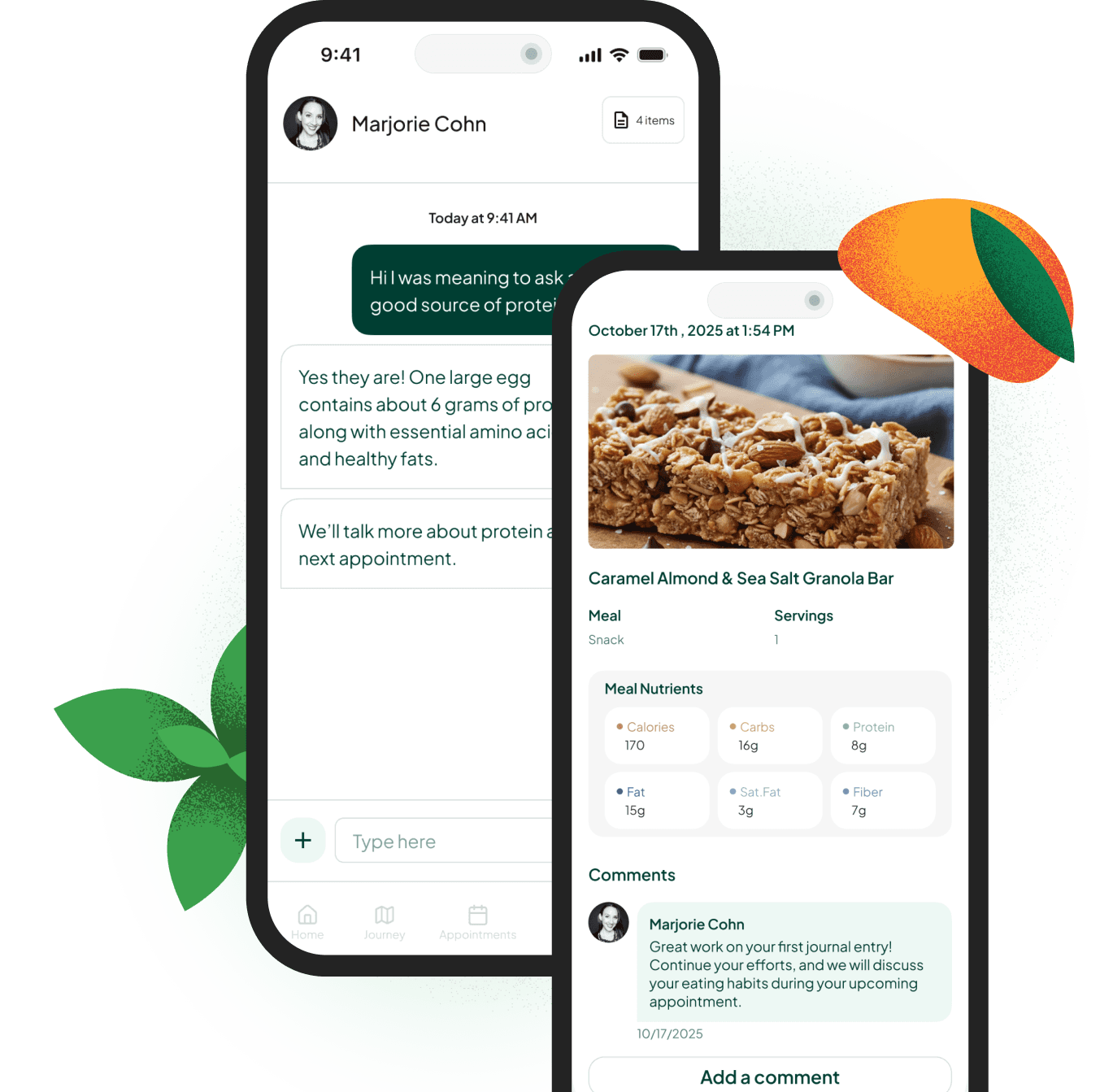
The real world happens between appointments, and that is where ongoing support makes a difference. With Berry Street, you can message your dietitian between visits, track your progress, and connect wearable and lab data so your plan reflects what is actually happening. If a new medication changes how you feel, or a restaurant meal spikes your blood sugar, you do not have to wait months to sort it out. You can raise it right away and adjust.

“Video calls and messaging between visits completely change what I can do for someone. With occasional in-person appointments, you’re guessing at what happened over the last few months. When a client can message me the day their new medication makes them nauseous, or send a photo of a meal they’re unsure about, we solve it in real time instead of at the next visit. That steady contact and accountability is often what turns a plan into lasting change for people managing a chronic condition.” — Bridget Isaacs, MS, RD
Is virtual medical nutrition therapy covered by insurance?
For a lot of people, this is the deciding question, and the news is generally good. Nutrition counseling is often a covered benefit, and many plans include it. Coverage still depends on your specific plan, so it is always worth checking before you assume anything one way or the other.
How coverage works and how to check yours
Many insurance plans cover MNT delivered by a registered dietitian, sometimes with no cost-sharing at all. With Berry Street, you can check your coverage in about 60 seconds by entering your state and insurance information, with no commitment required. You will see what you would pay before you book anything.
To put it in numbers, Berry Street is in-network with 1,250+ plans, and 95% of members pay $0. That does not guarantee your specific plan is covered, but it does mean the odds are in your favor, and checking is quick and free.
Getting started with a virtual dietitian for your chronic condition
If you have read this far, you already know the hard part is rarely knowing that nutrition matters. It is finding real, personalized support that fits your life. Here is a simple way to start, whenever you are ready.
Check your coverage. It takes about 60 seconds and there is no commitment. You will see your expected cost up front.
Get matched with a registered dietitian who specializes in your condition and understands your history.
Book your first video visit and start building a plan around your goals, your labs, and your real life.
There is no rush and no pressure. When it feels right, you can check your coverage and get matched with a dietitian. Your condition, your pace, your plan.

Frequently Asked Questions
Can a nutritionist or dietitian help manage a chronic condition online?
Yes. A registered dietitian nutritionist can provide medical nutrition therapy over video and messaging to help you manage conditions like type 2 diabetes, high blood pressure, and chronic kidney disease. Research suggests virtual care can achieve outcomes similar to in-person care for many people, and it works alongside your existing medical team.
Does insurance cover virtual medical nutrition therapy?
It depends on your plan. Many plans cover nutrition counseling, sometimes with no out-of-pocket cost, and with Berry Street you can check your coverage in about 60 seconds before booking. Berry Street is in-network with 1,250+ plans, and 95% of members pay $0.
What conditions can medical nutrition therapy help manage?
MNT can support a wide range of chronic conditions, including type 2 diabetes, prediabetes, high cholesterol, heart health, high blood pressure, chronic kidney disease, IBS, PMOS, and thyroid conditions. The Academy of Nutrition and Dietetics 2026 position paper found RDN-delivered MNT is effective for many chronic, nutrition-related conditions. Your dietitian tailors the approach to your specific situation.
Is a virtual dietitian as effective as seeing one in person?
Research suggests that, for many people, virtual RD care can achieve outcomes similar to in-person care, while some evidence indicates in-person contact may offer additional benefits for certain goals. A small 2024 trial found telenutrition was non-inferior to face-to-face care for blood sugar management in type 2 diabetes. Virtual care also makes it easier to stay consistent, which matters for long-term results.
What’s the difference between a nutritionist and a registered dietitian for chronic disease?
A registered dietitian nutritionist (RDN) is a credentialed clinician who completed an accredited degree, supervised training, and a national exam, and is qualified to provide medical nutrition therapy. “Nutritionist” on its own has no standardized national meaning, though some states do regulate the title and recognize the certified nutrition specialist (CNS) as an advanced credential. For a medical condition, working with a credentialed RDN or CNS is the safer choice.
How many virtual nutrition therapy sessions will I need to see results?
It varies by person, condition, and goals, so there is no single answer. Many people meet with their dietitian regularly at first and then space visits out as their plan stabilizes. Your dietitian will recommend a cadence based on your needs, and you can adjust it over time.
Do I need a doctor’s referral to see a virtual dietitian?
It depends on your plan. Many plans allow direct access, and with Berry Street you can usually book without a referral, though some plans do require one. Checking your coverage will tell you whether a referral applies in your case.
What actually happens during a virtual nutrition therapy appointment?
Your first video visit starts with an assessment of your labs, medications, symptoms, routines, and goals. From there, you and your dietitian build a personalized first plan with a few clear next steps. Between visits, you can message your dietitian, track progress, and adjust as life happens.
Can a virtual dietitian work alongside my existing medical team?
Yes, and that is the intended model. A registered dietitian provides nutrition care that complements your physician and specialists, not a replacement for them. Your dietitian can align your plan with your medications and lab targets and coordinate with your doctor.
How do I find out if my insurance plan covers medical nutrition therapy?
The fastest way is to check directly. With Berry Street you can check your coverage in about 60 seconds by entering your state and insurance information, with no commitment. Berry Street is in-network with 1,250+ plans, and 95% of members pay $0, and you will see your expected cost before you book.
Last Reviewed by Bridget Isaacs, MS, RD — October 2026.